
City Air Quality: A Deeper Dive

Model Explanation and Future Implications
Source
Model Explanation:
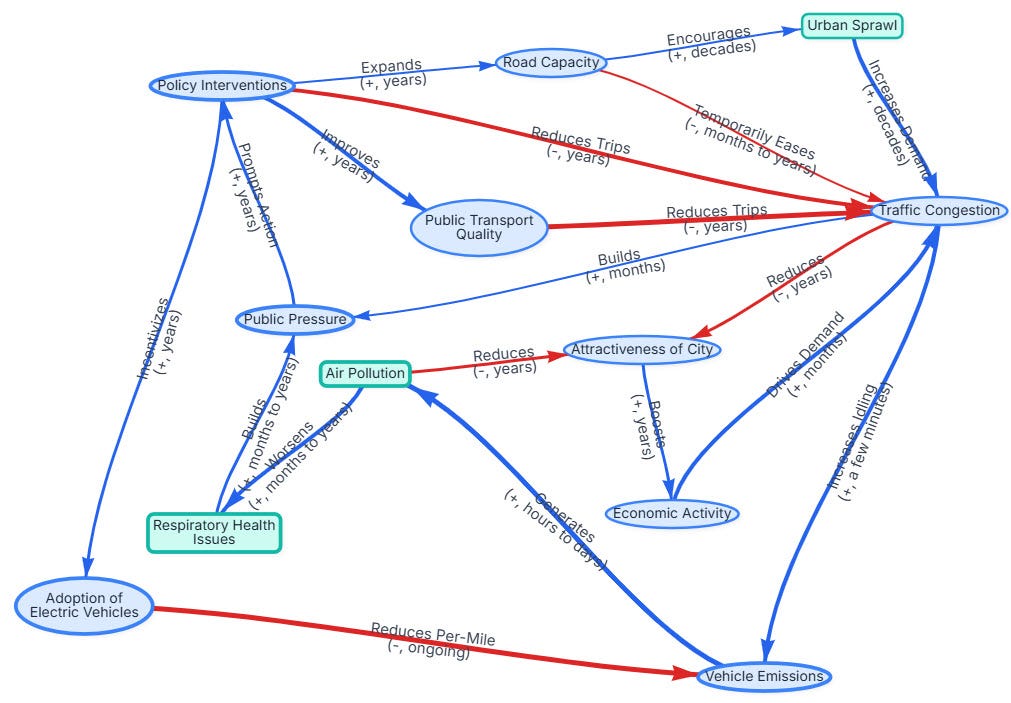
This Causal Loop Diagram (CLD) illustrates the complex, interconnected system that determines air quality in a modern city. At its core is a straightforward but damaging chain of events: increased Economic Activity and Urban Sprawl lead to a higher dependency on cars, which in turn creates Traffic Congestion. This congestion isn't just an inconvenience; it's an engine for pollution. Idling and inefficiently moving vehicles dramatically increase Vehicle Emissions, leading to a rise in the stock of Air Pollution. This directly and negatively impacts the stock of public health, manifesting as increased Respiratory Health Issues.
The model shows that the system does not exist in a vacuum. The worsening problems create Public Pressure, which acts as a trigger for Policy Interventions. However, the type of intervention is critical. The model highlights two distinct paths: a short-sighted path of simply increasing Road Capacity, and more systemic solutions like improving Public Transport Quality or incentivizing the Adoption of Electric Vehicles.
Future Implications:
The future trajectory of this system depends entirely on which feedback loops are allowed to dominate.
If Reinforcing Loops Dominate (The Downward Spiral): If the primary response to congestion is continually building more roads (the "Road Capacity Fix"), the R4: Urban Sprawl Trap loop will take hold. More roads will induce more demand for driving, encourage further sprawl, and lock the city into a car-dependent structure. Over time, congestion will return, pollution will worsen, and health issues will become endemic. The city's Attractiveness will plummet, leading to economic stagnation as businesses and talented individuals leave (the "Limits to Growth" archetype). The city becomes a less healthy, less efficient, and less desirable place to live—a hollowed-out version of its former vibrant self.
If Balancing Loops are Strengthened (The Path to Sustainability): If public pressure leads to wise policy interventions that strengthen the balancing loops, a different future is possible. By focusing on high-quality public transport and promoting clean vehicle technology, the city can decouple growth from pollution. Effective transit reduces the number of cars on the road, directly easing congestion. A widespread shift to electric vehicles breaks the link between emissions and traffic volume. In this future, the city can continue to thrive economically while improving public health and its overall attractiveness. This path requires foresight, investment, and a willingness to challenge the old paradigm of car-centric development.
Primary Insights of the Model
Interconnectedness: The model's most crucial insight is that urban air quality is not just an environmental issue. It is inextricably linked to transportation planning, public health, economic policy, and urban design. A decision made in one domain (e.g., approving a new low-density suburb) has powerful, cascading effects in all others.
The Danger of Delays: The system is riddled with significant time delays. It takes years for rising pollution to translate into widespread, undeniable health statistics. It takes more time for public pressure to build and force policy changes. It then takes even more years or decades for those new policies (like building a new subway line) to have a meaningful impact. During these delays, the problem continues to worsen, making it much harder to solve.
Short-Term Fixes Create Long-Term Problems: The most intuitive solution to traffic—building more roads—is revealed to be a "Fix that Fails." It provides temporary relief but ultimately reinforces the very problem it aims to solve by inducing more demand and enabling sprawl.
Primary System Archetypes
The behavior of this model is primarily driven by three classic systems thinking archetypes:
Fixes that Fail (B2 & R4): This is the most dominant archetype. The "fix" is increasing Road Capacity to solve the "problem symptom" of Traffic Congestion. This works for a short time (the balancing loop B2, "Road Capacity Fix"). However, it has a long-term, unintended consequence: it makes driving more attractive and enables Urban Sprawl, which increases Car Dependency and ultimately leads to more Traffic Congestion in the future (the reinforcing loop R4, "Urban Sprawl Trap"). The focus on the symptomatic fix distracts from addressing the fundamental problem.
Limits to Growth (B1): This archetype describes how a period of growth can run into a balancing process that slows it down. Here, the "engine of growth" is Economic Activity. This growth leads to the "slowing factors" of Traffic Congestion and Air Pollution, which decrease the city's Attractiveness. As the city becomes less attractive, it becomes harder to attract new businesses and residents, thus limiting further Economic Activity.
Success to the Successful: The Urban Sprawl Trap (R4) also acts as a "Success to the Successful" archetype. As resources (investment, infrastructure, political will) are allocated to roads, driving becomes the "successful" mode of transport. This starves public transport of the resources it needs to become a viable competitor. Over time, the car's dominance is reinforced not because it is inherently superior, but because the system has been structured to ensure its success at the expense of all other alternatives.
Leverage Points for Intervention
Using Donella Meadows' hierarchy of leverage points, we can identify places to intervene in this system, from least to most effective.
9. Numbers (Constants, parameters):
Intervention: Subsidies for electric vehicles, taxes on gasoline, road tolls.
Explanation: These actions change the financial parameters within the system. While helpful, they are low-leverage because the system's underlying structure (car dependency, sprawl) remains. People may simply pay the tax if no viable alternatives exist.
6. Structure of Information Flows (Who has access to information):
Intervention: Real-time, highly visible public dashboards displaying air quality data, hospital admission rates for asthma, and traffic congestion times, broadcast on public transport, news channels, and roadside displays.
Explanation: This is a medium-leverage point. By making the negative consequences of the system impossible to ignore, it shortens the delay in the "Problem & Response" loop (B5) and dramatically increases the strength and urgency of Public Pressure, making it harder for policymakers to ignore the problem or opt for short-term fixes.
5. Rules of the System (Incentives, punishments, constraints):
Intervention: Implement zoning laws that prohibit low-density sprawl ("anti-sprawl policies"). Mandate that all new developments must be mixed-use and meet high-density, transit-oriented design standards.
Explanation: This is a high-leverage point because it directly changes the rules that allow the "Urban Sprawl Trap" (R4) to function. It constrains the system's ability to expand in a car-dependent way, forcing development to align with more sustainable transport options.
4. The Power to Add, Change, Evolve, or Self-Organize System Structure:
Intervention: Invest heavily in creating a modular, adaptable, and high-quality public transportation network.
Explanation: This intervention adds a powerful new balancing loop ("Public Transit Solution," B3) that can effectively compete with the "Road Capacity Fix" loop. A robust transit system gives people a viable alternative to driving, empowering them to opt out of the congestion-creating system. It changes the structure by introducing a new, powerful choice.
2. The Goal of the System:
Intervention: Shift the city's primary planning and economic goal from "maximizing economic growth" to "maximizing resident health and well-being."
Explanation: This is one of the most powerful leverage points. The entire system is currently oriented around facilitating growth. If the overarching goal is changed, all decisions below it are re-evaluated. A