
America's Future: A Deeper Dive

Comprehensive Analysis of the “America’s Future” Causal Loop Diagram
This document provides an in-depth analysis of the causal loop diagram (CLD) titled “America’s Future.” The model explores the complex interplay between key social, economic, political, and environmental factors that collectively shape the nation’s trajectory.
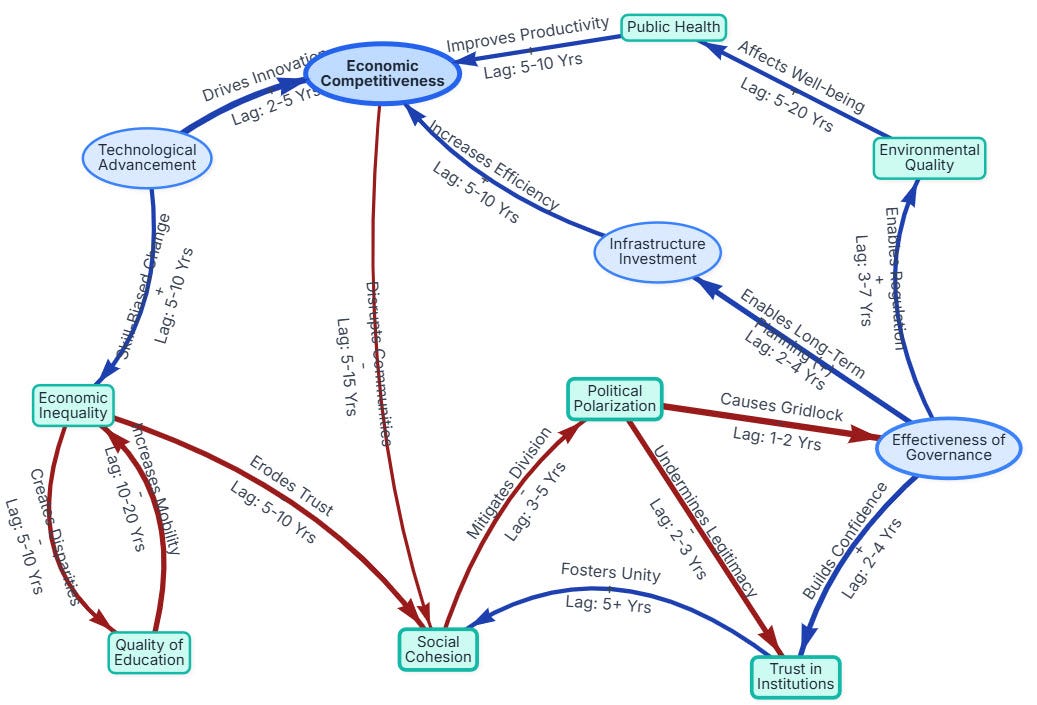
Model Explanation
The “America’s Future” CLD is a systems map designed to illustrate the interconnectedness of major forces influencing the nation’s long-term health and stability. It moves beyond single-cause explanations to show how various domains feed back into one another, creating reinforcing and balancing dynamics that can lead to either virtuous cycles of progress or vicious cycles of decline.
The model is structured around several key subsystems:
Socio-Economic Engine: This involves the relationship between Economic Inequality, Quality of Education, and Technological Advancement. It highlights how educational opportunities and technological shifts can either mitigate or exacerbate wealth disparities.
Socio-Political Core: This is a critical feedback system connecting Social Cohesion, Political Polarization, and Trust in Institutions. It demonstrates how societal unity (or lack thereof) directly impacts political functionality and public confidence.
Governance and Investment System: This links the Effectiveness of Governance to tangible national investments like Infrastructure and Environmental Quality, showing how political gridlock or progress translates into real-world outcomes.
National Well-being and Competitiveness: This subsystem connects the foundational elements of Public Health and Environmental Quality to the nation’s overall Economic Competitiveness on the global stage.
Source: America’s Future (Archetypes Experimental)
Wisdom
The core wisdom of this model is that the erosion of social cohesion and the rise of political polarization create a systemic trap that degrades the effectiveness of governance, preventing the nation from addressing fundamental challenges such as economic inequality, infrastructure decay, and environmental stress. While economic and technological engines are powerful, their benefits are undermined and unequally distributed by a dysfunctional socio-political system. The model suggests that America’s future prosperity is less a matter of resource or ingenuity and more a matter of restoring the social trust and political functionality required to make wise, collective, long-term decisions.
Donella Meadows’ 12 Leverage Points
Analyzing the model through the lens of Donella Meadows’ leverage points reveals the most effective places to intervene.
(12) Constants, parameters, numbers: Least Effective. Adjusting specific spending levels (e.g., a 5% increase in education funding) is a low-leverage action. While helpful, it doesn’t change the underlying system structure that creates educational disparities in the first place (R1).
(9) The length of delays: Intervening here is more effective. For example, shortening the delay between educational investment and improved economic mobility could weaken the “Inequality Trap” (R1). This could involve programs that more quickly translate skills into high-paying jobs.
(7, 6) The structure of feedback loops (Reinforcing & Balancing): This is a high-leverage area.
Weakening Reinforcing Loops: Interventions aimed at weakening the “Polarization Spiral” (R2) and “Distrust Spiral” (R3) are crucial. This could involve campaign finance reform, support for local journalism to rebuild community ties, or changes to social media algorithms that amplify division.
Strengthening Balancing Loops: The model currently shows powerful reinforcing loops and longer, more tenuous balancing loops. Creating or strengthening faster-acting balancing loops is a key leverage point. For instance, policies that directly link improvements in national well-being metrics to legislative incentives could create a new, powerful balancing force against short-term political maneuvering.
(4) The power to add, change, evolve, or self-organize system structure: This involves creating entirely new feedback loops. An example would be establishing citizen assemblies or other forms of deliberative democracy to develop non-partisan policy solutions for issues like infrastructure (n10) and environmental quality (n9), thereby bypassing the gridlock caused by political polarization (n3).
(2) The goals of the system: Very High Leverage. The model’s behavior is driven by implicit goals like short-term political victory and maximizing shareholder value. Shifting the national goal toward metrics like improving social cohesion or long-term well-being (incorporating public health and environmental quality) instead of just GDP would fundamentally alter every dynamic in the system.
(1) The paradigm out of which the system arises: Highest Leverage. The highest leverage point is to transcend the paradigm of “us vs. them” that fuels political polarization. A shift in the collective mindset toward recognizing shared destiny and the interconnected nature of national problems—understanding that inequality, poor health, and political gridlock ultimately harm everyone—would change the entire system from the ground up.
Knowledge
The model details several critical feedback loops:
R1: The Inequality Trap: A reinforcing loop where high inequality leads to educational disparities, which in turn limits economic mobility and solidifies existing class structures, reinforcing the initial high level of inequality over generations.
R2: The Polarization Spiral: A reinforcing loop where low social cohesion and low trust in institutions fuel political polarization. The resulting gridlock and inability to govern effectively further erodes trust and social cohesion, creating a vicious cycle of political dysfunction.
R3: Distrust Spiral: A reinforcing loop where political polarization directly attacks the legitimacy of institutions, which erodes public trust. Lower trust weakens social cohesion, making citizens more susceptible to polarizing rhetoric, thus completing the cycle.
B1: The Foundation of Prosperity: A long-term balancing loop. While effective governance enables investments that boost economic competitiveness, the social disruptions caused by globalization and economic shifts can weaken social cohesion, increase polarization, and ultimately degrade the effectiveness of governance that made the investments possible in the first place.
B2: Sustainable Prosperity: A similar long-term balancing loop where effective governance promotes environmental and public health. This leads to a more competitive economy, but the same disruptive social consequences can eventually circle back to undermine the governance needed to maintain those health and environmental standards.
Systems Archetypes
Two primary systems archetypes are driving the model’s behavior:
Success to the Successful: This archetype is clearly visible in the Inequality Trap (R1). Those with initial advantages (wealth) are able to secure better resources (education) for their children, who then achieve greater economic success, further concentrating wealth and advantage within that group. Meanwhile, those without initial advantages are allocated fewer resources, reinforcing their disadvantaged position.
Eroding Goals: The Polarization Spiral (R2) is a classic example of this archetype. The desired goal is effective, collaborative governance for the national good. However, as polarization intensifies, the short-term goal of partisan victory replaces the long-term goal. The perceived standard of acceptable governance slowly drops, and the system adapts to a new, lower-performing norm of gridlock and public distrust.
Primary Principles
The model demonstrates several key systems thinking principles:
Feedback Loops Dominate: The future is not a linear extrapolation of the present but is shaped by the reinforcing and balancing loops that amplify or counteract trends.
Delays Matter: The consequences of our actions are often separated from the actions themselves by significant time delays. The long lag between educational investment and reduced inequality (10-20 years) is a prime example, making it difficult to maintain political will for such policies.
Structure Determines Behavior: The problematic behaviors seen in the system (e.g., gridlock, rising inequality) are not the fault of individual actors but emerge from the underlying structure of interconnections.
Leverage Points Exist: Not all interventions are equal. The model shows that trying to tweak individual variables is far less effective than changing the structure of feedback loops, the goals of the system, or the underlying paradigm.
Key Insights
Social and political capital (Social Cohesion, Trust in Institutions) are as critical to the nation’s future as economic and technological capital.
Political Polarization is not just a symptom but a central driver of systemic dysfunction, creating gridlock that prevents solutions to nearly every other problem.
The connection between economic inequality and educational disparity forms a powerful reinforcing loop that threatens the American ideal of social mobility.
Long-term investments (in education, infrastructure, environment) are the most vulnerable to the short-term pressures created by political polarization.
Future Implications
If current trends continue, the reinforcing loops (R1, R2, R3) are likely to dominate. This suggests a future of deepening inequality, escalating political gridlock, and eroding public trust, leading to a decline in the nation’s ability to compete economically and solve complex problems like climate change.
A successful intervention would focus on weakening these reinforcing loops and strengthening the balancing ones. A future where the nation successfully invests in equitable education and implements reforms to reduce polarization could reverse these trends, leading to a renewal of social cohesion, more effective governance, and a restoration of shared prosperity. The system has the capacity for self-correction, but it requires activating the high-leverage points.
Synthesis of Core Wisdom and Highest Leverage Point
The core wisdom of the model is that America’s interconnected social and political systems are caught in a reinforcing spiral of distrust and division, which is the primary obstacle to a prosperous future.
Therefore, the highest leverage point is to transcend the paradigm of zero-sum, partisan conflict. This involves shifting the collective mindset to recognize that the fates of all Americans are intertwined and that challenges like inequality and institutional decay are shared problems, not partisan weapons. Interventions at this level are not about specific policies but about fostering a new public narrative focused on shared goals, civic renewal, and the fundamental principles of a pluralistic democracy. It is about changing the conversation from “winning” to “problem-solving” and, in doing so, changing the goal of the entire system.