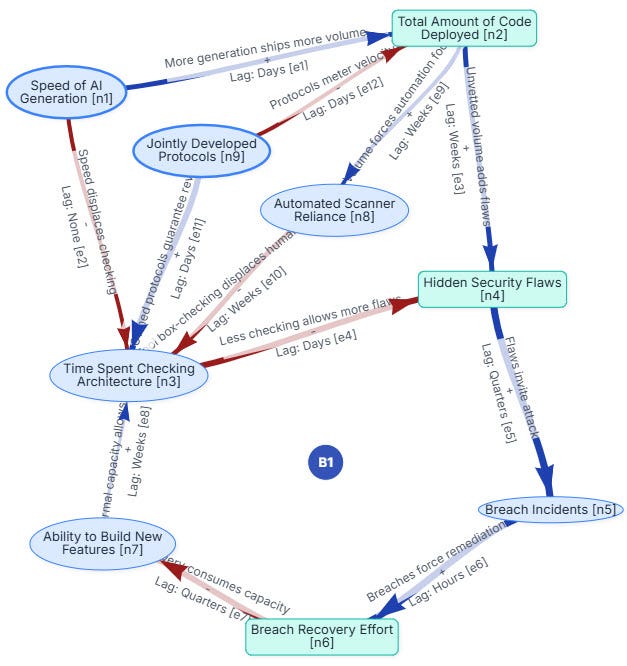
AI Code Speed vs System Resilience
An Aha! Mystery - Deciphering the Mess

This post is not meant as an answer,
though more of a process for creating food for thought on a topic.
The “Vibe Coding” Cybersecurity Vulnerability
The Current Event: The massive adoption of AI code-generation tools has led to an explosion of rapid software deployment. Concurrently, major tech policy summits are warning of a massive spike in cyber breaches caused by vulnerabilities in AI-generated, untested code.
The “Aha!” Angle: This is a classic efficiency trap. Teams use AI to write code at lightning speed, assuming they are dramatically increasing productivity. But because the software lacks rigorous human architectural vetting, it creates an expanded attack surface for adversaries using their own autonomous AI hacking agents. The time “saved” upfront is paid back with exponential interest during a breach recovery.
The Question: What happens to systemic resilience when the speed of production permanently outpaces the depth of understanding?
The Ghost in the Velocity Machine
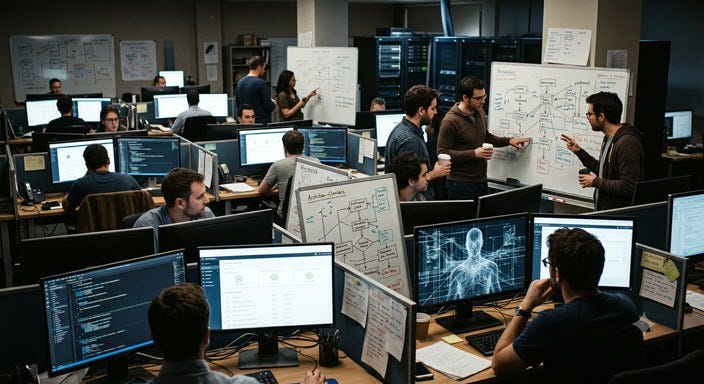
The glow of the monitors never truly faded in the open-plan engineering bay; it merely shifted in intensity, casting long, pale shadows across rows of empty desks where people used to think. The air was thick with the faint hum of server racks and the invisible, crushing weight of a relentless deadline. Everyone was moving at an absolute sprint, driven by a shared, unspoken delusion: that if they could just push code out the door fast enough, they would finally outrun the crushing backlog and prove their worth. The adoption of the new AI generation tools had felt like a miracle at first, a sudden burst of hyper-velocity that made everyone feel like a wizard. Code was flowing like water from a broken dam, filling the repositories with thousands of clean, shimmering lines in a matter of seconds. Yet, beneath the surface of this sudden bounty, an exhausting emptiness was settling into the team. They were shipping features at lightning speed, but no one actually understood how the pieces fit together anymore; the deep, quiet spaces where architects used to sit with a cup of coffee, sketching out relationships and data boundaries on whiteboards, had been entirely dismantled to make room for the rush. The truth of the situation was undeniable, though it took a long time for anyone to find the words to say it out loud: they had traded the deep, stabilizing sanctuary of human understanding for the cheap illusion of production speed, and in doing so, they had systematically hollowed out their own resilience.
The turning point did not come with a dramatic alarm, but with a quiet realization in the middle of a Tuesday afternoon. Elena, a senior engineer who had spent the last three years watching her team shift from meticulous craftspeople to harried button-pushers, sat staring at a sprawling codebase that an AI assistant had generated in under three minutes. It was beautiful, syntactically perfect, and completely alien. When she asked her junior developers how a specific data pocket was secured, they pointed to the automated compliance scanner, a superficial gatekeeper that management had installed to ensure speed wasn’t compromised. The scanner’s dashboard was a sea of bright, cheerful green checkmarks, a soothing digital reassurance that everything was safe. But Elena looked past the green lights and felt a cold wave of clarity pass over her. The automated tools were being treated like a corporate checklist, a way to clear the hurdle without ever engaging the brain; her team was tweaking the configuration files and fragmenting the code just enough to make the scanner happy, all while remaining completely blind to the systemic vulnerabilities accumulating in the dark. They had built a mountain of unvetted software, and out in the wild, autonomous hacking agents were already scanning the horizon, waiting for the inevitable moment when the unexploded logistical tax would come due. The realization struck her with the force of an physical blow: they weren’t building a future; they were just constructing a grander, flashier target for an adversary that thrived on their lack of depth.
Instead of running faster or demanding a more complex automated scanner to fight the symptoms, Elena did something that felt entirely counter-revolutionary in an environment obsessed with velocity: she called a halt. She gathered the visionaries who still dreamed of elegant, systemic design and the pragmatists who were utterly exhausted by the endless cycle of emergency patches and midnight fire-drills. Standing before them, she didn’t offer a new piece of software or a stricter mandate from above. Instead, she asked them to help her map out the overarching intent of what they were actually trying to protect. Together, in a room stripped of automated tools and metrics, the developers began to co-create their own safety protocols from scratch. They designed deliberate, human-centric gates that could not be automated away or bypassed by a clever configuration tweak, forcing themselves to step back into the active role of architects. The initial friction was real; the speed of production slowed down, and the daily code volume dropped from a roaring river to a steady, mindful stream. But as the team took ownership of the safety structures they had authored with their own hands, the emotional landscape of the room shifted from frantic anxiety to a grounded, quiet confidence. They were no longer running a race they were destined to lose; they had anchored themselves to a shared understanding, discovering that the only way to build a genuinely resilient movement is to ensure that the depth of human comprehension always stays one step ahead of the tools we create. Thank you to everyone who sat in those rooms, embraced the slow, painful trial of learning, and chose the hard work of mutual alignment over the easy trap of effortless speed.
The Story source file also contains First Principles, Core Wisdom, Systemic Paradoxes, Leverage Points, and Stakeholder Resonance.
The Story conveys what, the model shows why, and the transcript explains how. You can access the files associated with this post in the “AI Code vs System Resilience” folder. To try the Aha! Mystery process, send systemswiki@gmail.com an email, and I’ll send you the prompts.
The dialogue, if you care to read it: https://gemini.google.com/share/98f113363b12
Unique Perspectives on the Topic
You can download the models from the directory above.
Vibe Coding Cybersecurity Vulnerability v1
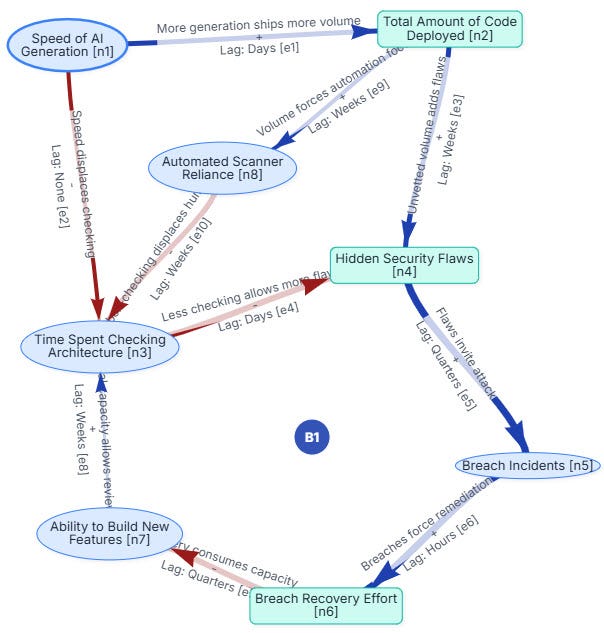
Vibe Coding Cybersecurity Vulnerability v2