
A Decolonized World: A Deeper Dive

Comprehensive Analysis: A Decolonized World
This document provides a detailed analysis of the “A Decolonized World” causal loop diagram, examining its structure, underlying principles, and strategic implications for fostering genuine decolonization.
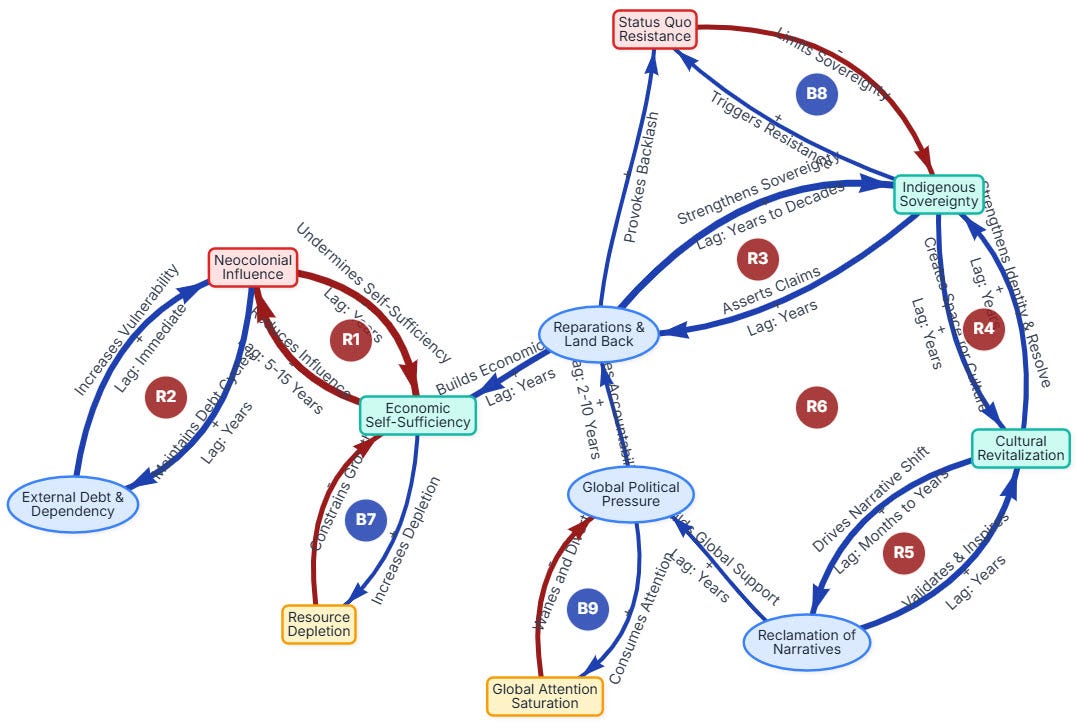
1. Model Explanation
The “A Decolonized World” model is a systems thinking diagram that illustrates the complex, interconnected forces driving and hindering the process of decolonization. It moves beyond a linear view of political independence to map the dynamic feedback loops that influence everything from cultural identity to economic dependency.
The model identifies several key stocks, which represent accumulations or levels of a particular quantity. Core stocks include:
Indigenous Sovereignty: The collective authority of Indigenous peoples.
Cultural Revitalization: The strength of Indigenous languages, traditions, and knowledge.
Economic Self-Sufficiency: The control of a community over its own economic destiny.
Neocolonial Influence: The persistent colonial-style exploitation through non-direct means.
These stocks are influenced by various flows and feedback loops. The model contains six reinforcing (R) loops, which create exponential growth or decline, and three balancing (B) loops, which seek equilibrium and resist change. For example, the “Sovereignty Engine” (R1) shows how sovereignty and land back mutually reinforce each other, while the “Political Backlash” loop (B7) illustrates how growing sovereignty can trigger resistance, thus limiting its own growth.
Source: A Decolonized World (Archives
2. Wisdom
The core wisdom of this model is that decolonization is not an event, but a self-perpetuating process of reclaiming identity that is inseparable from political and economic autonomy. The model reveals that the most resilient and powerful driver of change comes from within Indigenous communities themselves. The interconnected loops of Cultural Revitalization (R2), Identity and Power (R3), and the overarching Global Justice Loop (R6) demonstrate that strengthening cultural identity and reclaiming narratives is not a “soft” or secondary aspect of decolonization; it is the fundamental engine. This internal strengthening creates the political will and global pressure required to achieve tangible gains like sovereignty and land back. It reframes decolonization from a simple political negotiation into a profound act of cultural and psychological liberation that precedes and drives structural change.
3. Donella Meadows’ Leverage Points
Applying Donella Meadows’ framework for leverage points helps identify where to intervene in this system for maximum effect.
9. Length of Delays (Low Leverage): The model explicitly notes delays of “Years to Decades” in loops like R1. Shortening the time it takes for legal claims to be settled or for land back to translate into sovereignty could accelerate the process, but this is difficult to change.
6. Structure of Information Flows (Moderate Leverage): The Reclamation of Narratives (n6) is a key information flow. Interventions that amplify Indigenous-led media, reform educational curricula, and challenge colonial histories in public discourse directly strengthen the R2, R3, and R6 loops. This is a powerful leverage point.
4. The Power to Add, Change, Evolve, or Self-Organize System Structure (High Leverage): The very act of Indigenous peoples forming self-governing institutions (Indigenous Sovereignty, n1) is an example of self-organization. Supporting the creation and recognition of these new structures is a high-leverage intervention because it fundamentally changes the system’s ability to govern itself.
2. The Mindset or Paradigm out of which the System Arises (Highest Leverage): The highest leverage point is the paradigm of colonialism itself—the belief in cultural, racial, and political hierarchies. The Reclamation of Narratives directly targets this mindset. By changing the stories a society tells itself, it challenges the legitimacy of colonial structures and the resistance they generate (n9). A shift in the global paradigm from one of colonial assumptions to one that values Indigenous sovereignty and knowledge makes every reinforcing loop stronger and every balancing loop weaker.
4. Knowledge
This section details the explicit components defined within the systems model.
Stocks (Key Variables):
Indigenous Sovereignty (n1)
Cultural Revitalization (n2)
Economic Self-Sufficiency (n3)
Neocolonial Influence (n4)
Status Quo Resistance (n9)
Resource Depletion (n10)
Global Attention Saturation (n11)
Flows (Key Actions/Processes):
Reparations & Land Back (n5)
Reclamation of Narratives (n6)
External Debt & Dependency (n7)
Global Political Pressure (n8)
Feedback Loops:
Reinforcing Loops (Engines of Change):
R1: The Sovereignty Engine: Sovereignty ↔ Land Back
R2: Cultural Renaissance: Cultural Revitalization ↔ Narrative Reclamation
R3: Identity and Power: Sovereignty ↔ Cultural Revitalization
R4: The Neocolonial Trap: Economic Self-Sufficiency ⊣ Neocolonial Influence (a virtuous cycle when influence is reduced)
R5: The Debt Spiral: Neocolonial Influence ↔ External Debt
R6: The Global Justice Loop: A large macro-loop connecting sovereignty, culture, narratives, global pressure, and land back.
Balancing Loops (Limits & Resistance):
B7: Political Backlash: Growing Sovereignty → Status Quo Resistance → Limits on Sovereignty.
B8: Resource Limits: Economic Growth → Resource Depletion → Constraints on Growth.
B9: Attention Saturation: Global Pressure → Attention Saturation → Waning Pressure.
5. Systems Archetypes
The model clearly illustrates two classic systems archetypes:
Limits to Growth: This archetype is present in multiple places. The primary reinforcing loop, “The Sovereignty Engine” (R1), fuels the growth of decolonization. However, its progress is checked by the balancing loop of “Political Backlash” (B7). As sovereignty grows, it generates resistance, which slows further growth. Similarly, the drive for “Economic Self-Sufficiency” (R4) is limited by “Resource Limits” (B8). The system shows that growth cannot continue indefinitely without encountering constraints.
Shifting the Burden: This archetype is visible in the dynamic between economic self-sufficiency and debt. The fundamental, long-term solution to economic hardship is to build “Economic Self-Sufficiency” (strengthening loop R4). However, a “quick fix” is to take on “External Debt” (n7). This symptomatic solution alleviates short-term pain but strengthens the “Debt Spiral” (R5), which increases “Neocolonial Influence” and ultimately undermines the ability to build true self-sufficiency. The burden is shifted from fundamental solutions to superficial ones that create deeper dependency.
6. Primary Principles
Sovereignty is Self-Reinforcing: The model’s core reinforcing loops (R1, R3, R6) show that gains in sovereignty, culture, and land create the conditions for further gains.
Culture is Structure: Cultural revitalization is not just an outcome of decolonization but a primary driver of the political and economic shifts required to achieve it.
Neocolonialism is a Vicious Cycle: The “Neocolonial Trap” (R4) and “Debt Spiral” (R5) illustrate how economic dependency is a self-perpetuating system that actively undermines autonomy.
Growth Invites Resistance: The “Limits to Growth” archetype (B7) is a fundamental principle; any successful effort to change a system will inevitably provoke a counter-reaction from those who benefit from the status quo.
Global Awareness is a Finite Resource: The “Attention Saturation” loop (B9) highlights the practical reality that global political pressure cannot be sustained at peak intensity indefinitely and must be strategically focused.
7. Key Insights
Invest in Culture to Win Politically: The most resilient strategy for decolonization is to focus on strengthening the internal loops of cultural revitalization and narrative reclamation. These create the enduring social cohesion and political will that external resistance cannot easily break.
Beware the “Quick Fix”: Aid and loans that come with strings attached (the “Shifting the Burden” archetype) are a trap. True progress requires prioritizing long-term economic self-sufficiency, even if it is a slower and more difficult path.
Anticipate and Plan for Backlash: The “Political Backlash” loop (B7) is not a sign of failure but a predictable consequence of success. Strategies must include measures to mitigate and counter this resistance.
Narrative is the Battlefield: The struggle for decolonization is a struggle over stories. The power to define history, identity, and justice is the power to change the system’s paradigm.
8. Future Implications
The model suggests several possible future scenarios:
Vicious Cycle Dominance: If neocolonial influence remains strong and the “Debt Spiral” (R5) continues, nations may achieve nominal independence but remain trapped in economic dependency, leading to resource depletion and continued erosion of sovereignty.
Stagnation at the Limit: Decolonization efforts may see initial success but stall as they hit the “Limits to Growth” barriers—strong political backlash and resource limitations that they cannot overcome. This results in a frustrating equilibrium where progress is constantly checked.
Virtuous Cycle Breakthrough: If there is a significant and sustained investment in the internal loops (R2, R3) and a successful “Reclamation of Narratives,” it could create enough momentum in the “Global Justice Loop” (R6) to overcome the balancing forces. A critical mass of global political will could weaken the “Political Backlash” and provide the support needed to break free of the “Neocolonial Trap,” leading to accelerating and resilient decolonization.
9. Synthesis: Core Wisdom & Highest Leverage Point
The core wisdom of the model is that authentic decolonization is an internal process of cultural and psychological liberation that builds the collective power to achieve external sovereignty.
The highest leverage point is therefore to transcend the colonial paradigm by changing the dominant narrative. The act of Reclamation of Narratives (n6) is the intervention that most directly addresses this paradigm. By challenging colonial histories and centering Indigenous perspectives, this action weakens the very foundation of neocolonial influence and status quo resistance. It transforms the global perception of justice, making actions like land back and reparations not radical demands, but logical and necessary acts of redress. Shifting the story is the most powerful way to shift the system.